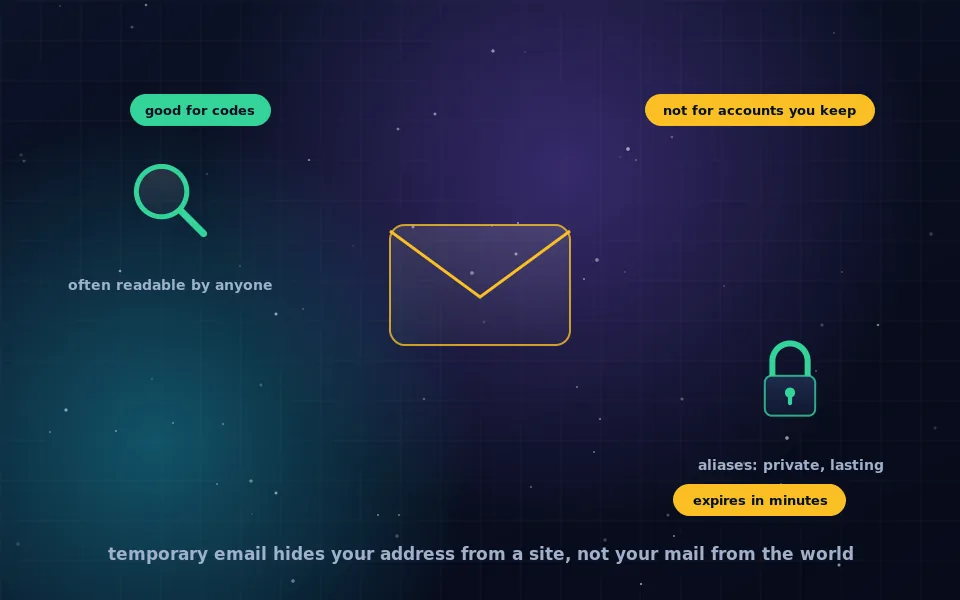
A temporary anonymous email address is a throwaway inbox created by a website, valid for minutes to a day, that you give to services instead of your real address. It is the right tool for receiving a one-time verification code or a download link from a site you do not trust. It is the wrong tool for anything you need to keep, anything private, or any account you will log into again.
The appeal is obvious. Every site wants an address, most of them will sell or leak it, and a disposable inbox costs nothing and takes seconds. Used for what it is good at, temp email keeps your real inbox clean and your real address out of breach dumps. Used for the wrong things, it exposes messages to strangers and locks you out of accounts. This guide draws the line, compares disposable inboxes with the alias features of privacy email providers, and covers the handful of safety rules that make temp email safe to use.
How disposable inboxes work
You visit a temporary email site and it shows you an address, either random or one you choose, on a domain it controls. Any mail sent to that address appears in the web page, usually without any login. After a set period the address expires and the messages are deleted, or the address becomes available for someone else to use.
Three properties follow from that design, and they explain everything else in this article.
- There is often no account and no password, so on many services the inbox is readable by anyone who types the same address.
- The address is on a domain the service publicly operates, so websites can recognise it as disposable.
- The service sees your IP address and the contents of everything received, and its retention and logging vary widely.
Some paid or semi-private temp services add a login or a random unguessable address to close the first gap. Even so, treat the inbox as shared unless the service clearly states otherwise.
What temporary email protects
Used correctly, a disposable address protects your real inbox and your real identity from the site you are signing up to. Specifically it stops the site from spamming your main address, from selling it to marketers, from exposing it in a breach, and from linking that signup to your other accounts through a shared address. For a one-time download, a trial, a forum you will read once, or a coupon, that is the entire risk and temp email covers it.
It does not protect the contents of the mail from the temp service or, on public services, from other visitors. It does not hide your IP address unless you visit the temp site through Tor or a VPN. And it does not protect anything after the address expires.
When not to use a temporary address
The failures are predictable, and each has stranded real people.
- Accounts you will use again. Password resets, login codes and security alerts go to an address that no longer exists. Worse, on public services another visitor could later generate the same address and reset your password.
- Anything with money. Shops, marketplaces and payment services send receipts, disputes and verification codes for months. A disposable address cannot receive them.
- Anything private. Medical, legal or personal correspondence sent to a shared inbox can be read by strangers.
- Anonymous conversations. If you need to exchange messages over days or weeks without revealing yourself, use a proper anonymous account created over Tor, as the guide on this site describes. Temp inboxes vanish mid-conversation.
- Sites that verify by clicking a link later. If confirmation takes longer than the inbox lifetime, the account is unusable.
The rule is simple: if you would be upset to lose access to the address tomorrow, or to have a stranger read what arrives, it is not a temp email situation.
Aliases: the better tool for anything ongoing
Privacy-focused email providers, and some dedicated alias services, let you create extra addresses that forward to your real inbox. Each alias looks like an ordinary address, lasts as long as you want, and can be disabled with one click when it starts receiving spam. Because you control the alias, nobody else can read its mail or take it over.
Aliases give you the same benefit as temp email, a unique address per site, without the fragility. The site gets an address that reveals nothing about your main one; if it leaks, you know exactly which site leaked it, and you turn that alias off. For anonymity toward the site, aliases also hide any pattern in your main address. For the strongest separation, keep the aliases at an anonymous account rather than a personal one, so that even the provider link does not lead back to you.
If your provider does not offer aliases, this feature alone is a reason to consider one that does; the provider comparison on this site lists it among the criteria.
Using temp email safely: a six-point checklist
When a disposable address is the right choice, a few habits remove most of the risk.
- Open the temp service through Tor Browser or a VPN so the service does not record your home IP address alongside the messages it receives for you.
- Prefer services that generate long random addresses over ones that let you pick a short memorable one, because a guessable address is a readable inbox.
- Never reuse a temp address across sites or sessions; generate a fresh one every time.
- Copy the verification code or link the moment it arrives and then leave; do not use the inbox to receive anything else.
- Never send from a temp address anything you would not post publicly.
- If the site rejects the address as disposable, switch to an alias rather than trying other temp domains, which often signals to the site that you are trying to evade its rules.
Anonymous email generators and sending features
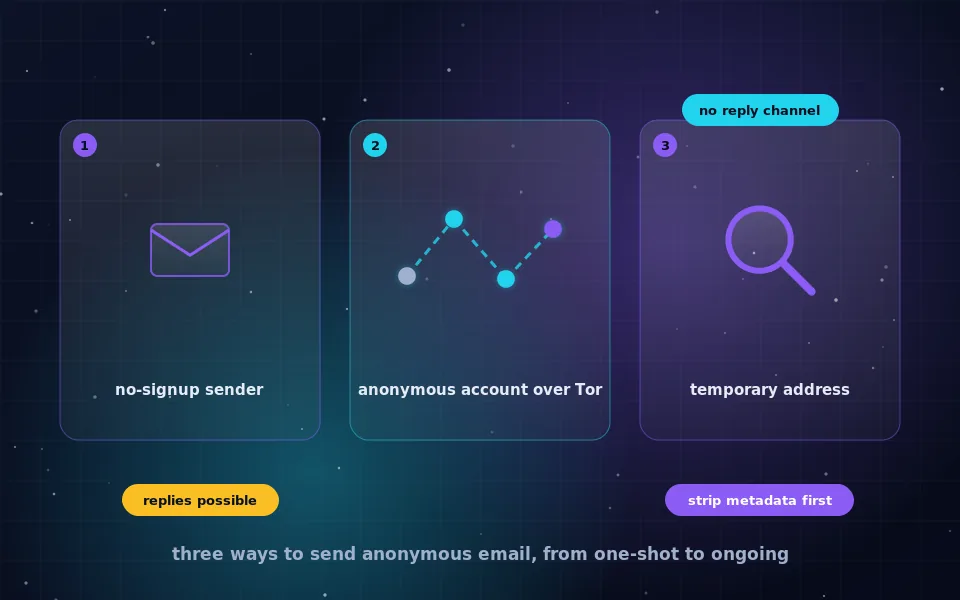
Some temp services advertise themselves as anonymous email generators and include a sending feature. The generated address is fine for receiving codes. Sending from it has two problems: the mail is heavily filtered because the domain is known for disposable use, and the service records the sending IP address and content. For an anonymous message that must arrive, the guide on sending anonymous email on this site describes better options, from no-registration senders over Tor to a proper anonymous account.
What security practitioners observe about disposable email
The advice above matches what people who deal with account security and abuse have seen in practice.
Account-security teams at online services have documented cases where users registered with temporary addresses, lost access when the address expired, and could not recover their accounts, and cases where a later user of the same disposable address triggered password resets on the earlier user's account. That is the origin of the rule against using temp email for anything you keep.
Anti-abuse researchers note that lists of disposable email domains are widely shared among websites, which is why signups with temp addresses are often blocked, and why aliases on ordinary-looking domains are more reliable.
Privacy educators who teach compartmentalisation describe disposable inboxes as a tool for reducing the spread of your real address, and recommend aliases at a trusted provider for anything that matters, reserving temp email for genuinely one-time interactions. This article follows the same division.
Use it for what it is good at
Next time a site demands an address for a download or a one-off code, open a temp email service through Tor or a VPN, grab a random address, take the code and close the tab. For everything you will use again, create an alias at your email provider instead. Keeping those two tools in their lanes is the whole of using temporary anonymous email well.
Frequently asked questions
What is a temporary anonymous email?
A disposable address generated by a website, with an inbox you can read in the browser for a limited time, usually minutes to a day. You give it to a service instead of your real address, receive the confirmation or code, and let it expire.
Is temporary email really anonymous?
It hides your real address from the site you sign up to. It does not hide your IP address from the temporary email service unless you use Tor or a VPN, and on many services the inbox can be read by anyone who enters the same address, so it is anonymous but not private.
Can I use anonymous temp email for accounts I want to keep?
No. The address expires, so password resets and security alerts will be lost, and on public temp services someone else could later claim the same address and take over the account. Use an alias from your own privacy email provider instead.
What is the difference between a temp email and an alias?
A temp email is a throwaway address on a shared service that disappears. An alias is an extra address you create at your own email provider that forwards to your inbox, lasts as long as you want, and can be disabled when a site starts spamming you. Aliases are the right choice for anything ongoing.
Do sites block temporary email addresses?
Many do, by keeping lists of known disposable domains. If a signup rejects your temp address, use an alias from your own provider, which looks like an ordinary address.
Last reviewed and updated on . Plain text version: /anonymity/temporary-anonymous-email.txt.