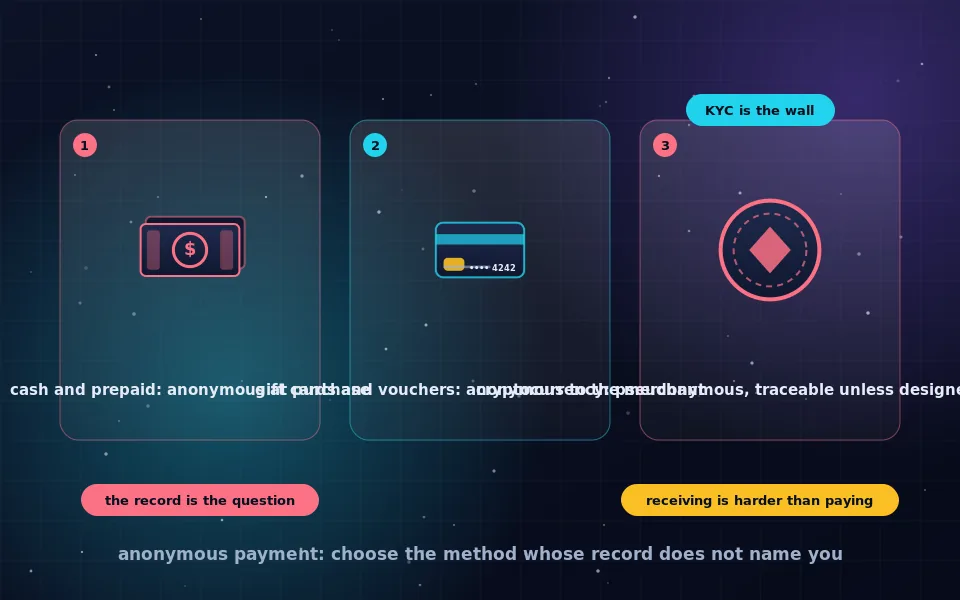
The most anonymous payment method is cash handed over in person; online, the closest equivalents are prepaid cards and gift cards bought with cash, and privacy-focused cryptocurrencies used with care. Ordinary credit cards, bank transfers and payment apps identify you to the provider, though virtual card numbers can hide your real card from the merchant. Receiving money anonymously is harder than paying, and every method runs into legal identification requirements above modest amounts.
People want anonymous payment for ordinary reasons: keeping a purchase off a shared bank statement, donating without a paper trail, paying for privacy services without linking them to a name, or not handing card details to an unfamiliar merchant. This guide ranks the options by who ends up with a record, explains what anonymous credit card payment can and cannot mean, covers receiving money anonymously, and sets out the legal limits that apply to every method.
The record is the question
No payment is invisible. Cash is counted by the recipient, cards are logged by banks and merchants, cryptocurrency is written to a public ledger. Anonymous payment means the record that exists does not connect to you.
For each method, ask three questions. Does the payment provider know who I am? Does the merchant learn who I am? Can the record be connected to me later by someone with access? Cash answers no to all three in a face-to-face purchase. A credit card answers yes to all three. Everything else lies between.
Payment methods ranked by anonymity
From most to least anonymous, for the payer.
- Cash in person. No provider, no record naming you. Limits: only for local, in-person purchases, and legal reporting thresholds apply to large amounts.
- Prepaid debit cards bought with cash. Work like a card online and in shops. Anonymous if bought with cash and not registered. Limits: many issuers require registration for online use or reloads, amounts are capped, and some merchants reject them.
- Gift cards and vouchers bought with cash. Redeemable at the issuing merchant or platform. Anonymous to the merchant. Limits: single merchant or ecosystem, and resale markets for gift cards are full of fraud.
- Privacy-focused cryptocurrency. Coins designed to hide sender, recipient and amount. Strong on-chain privacy. Limits: acquiring them usually requires an identified exchange or a peer-to-peer trade, few merchants accept them, and price volatility.
- Mainstream cryptocurrency. Pseudonymous: addresses are not names, but every transaction is public and analysis firms link addresses to identities routinely, especially through exchanges that require identification. Useful for some privacy services, not anonymous by default.
- Virtual card numbers. A disposable number tied to your real card or bank account. The merchant does not learn your real card, and cannot charge it again. The bank knows everything. Private, not anonymous.
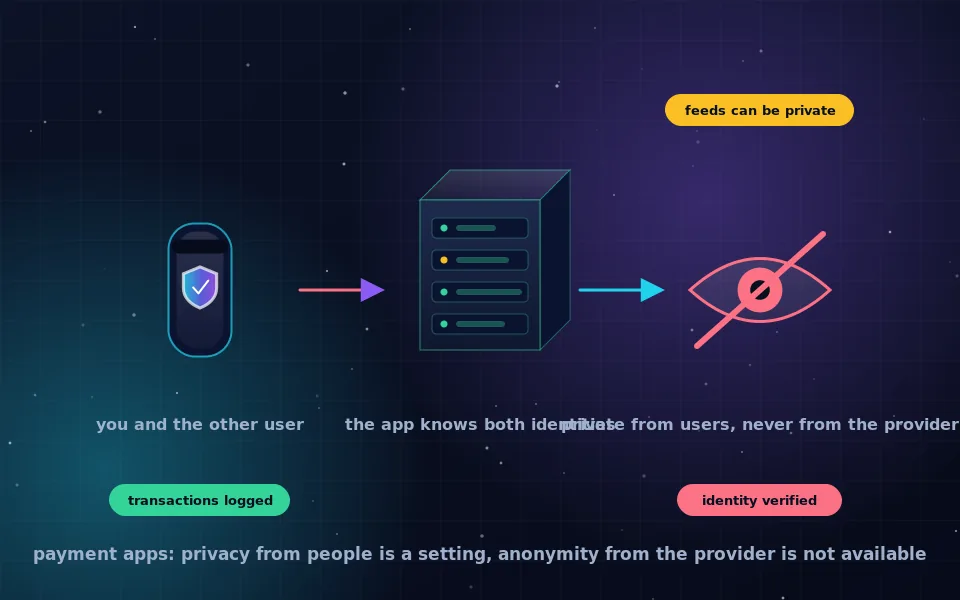
- Payment apps and bank transfers. Fully identified to the provider and usually to the counterparty. The apps guide on this site explains what privacy settings can and cannot do.
What anonymous credit card payment really means
A credit card is a line of credit issued to a verified person, so an anonymous credit card does not exist. Searches for the phrase usually want one of two things.
If the goal is to keep your card details away from a merchant, a virtual card number from your bank or a virtual card service does exactly that: the merchant gets a number that works once or only at that merchant, and your real card is never exposed. Your bank still sees the charge with the merchant's name, so it appears on your statement.
If the goal is that no one knows who paid, a prepaid card bought with cash is the tool. It carries a card network logo and works at most online merchants like a debit card. Choose one that can be used online without registering personal details, which is increasingly rare; check the terms before buying. Amounts are limited, and it cannot be reloaded anonymously in most places.
Cryptocurrency, honestly
Cryptocurrency is often assumed to be anonymous and mostly is not. On transparent blockchains, every transaction is public forever, and when you buy coins at an exchange that verified your identity, the coins are linked to you. Blockchain analysis firms trace flows for exchanges and law enforcement as a business. Reusing addresses, consolidating funds and cashing out through an identified exchange all connect activity to a name.
Privacy-focused coins hide amounts and parties by design and resist this analysis substantially. Their practical limits are acquisition, since most exchanges that list them require identification and some have delisted them; acceptance, since few merchants take them; and the need to understand wallets and transaction hygiene. For paying a privacy service that accepts them, they are the strongest online option. For everyday purchases, they are impractical.
Receiving money anonymously
Receiving is the harder direction, because the payer's method reaches you at an endpoint that usually has your name. A bank account or payment app identifies you to the provider even if the sender knows only a username. Realistic options are limited.
- Cash in person, for local transactions.
- Gift card codes sent to an anonymous email address, redeemable at the issuer.
- Cryptocurrency to a fresh address you control, with the caveats above about converting it to spendable money.
- A payment processor account opened under a business or pseudonym, which is legal in some places for some purposes and requires identification to the processor regardless.
Anyone offering to help you receive significant sums anonymously through their accounts is describing money laundering, and the guide stops there.
A six-step approach to paying anonymously
- Decide who must not know about the payment: the merchant, your bank, a person who sees your statements, or anyone at all. The answer picks the method.
- For hiding a purchase from a shared statement, a virtual card or a prepaid card is enough.
- For not giving a merchant your identity, a prepaid card or gift card bought with cash.
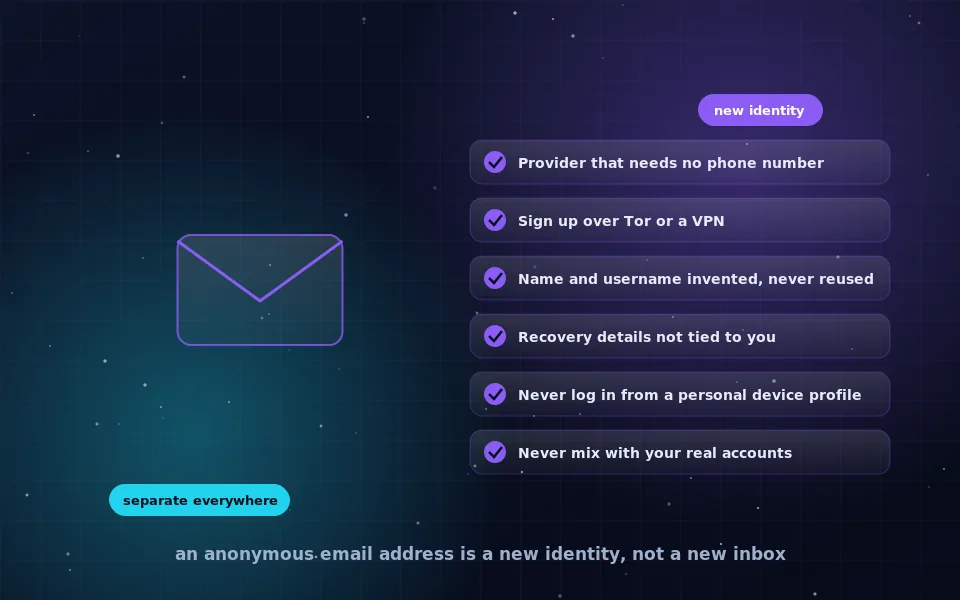
- For paying a privacy service without a link to you, a prepaid card, a gift card the service accepts, or a privacy coin, purchased and used through an anonymous email and Tor as the guides on this site describe.
- Keep the anonymous payment separated from your identity in every other way: delivery address, email, account name, IP address. A cash-bought card used with your home address anonymises nothing.
- Stay within legal limits and keep records for yourself if the payment is one you may need to explain later.
The legal limits
Every jurisdiction requires financial providers to identify customers, sets thresholds above which cash transactions must be reported, and restricts anonymous prepaid instruments in amount and function. These rules exist to prevent laundering and fraud, they are tightening rather than loosening, and they mean that anonymous payment in practice is a tool for modest amounts and specific purposes, not a way to move money invisibly. Paying anonymously for lawful things is legal in most places. Using anonymity to evade tax, launder proceeds or buy prohibited goods is not, and no method above changes that.
What regulators, researchers and privacy services observe
The ranking here reflects how the methods behave in practice and how they are treated.
Financial regulators describe cash as the only fully anonymous instrument and have progressively limited prepaid cards, requiring registration for reloads and online use in many markets, precisely because of their anonymity.
Blockchain analysis researchers and firms have documented that transparent cryptocurrencies are traceable at scale and that most identification happens at exchanges, while acknowledging that well-designed privacy coins resist their techniques.
Privacy-focused service providers that accept anonymous payment commonly list cash by post, prepaid or gift cards, and privacy coins as their accepted anonymous methods, and note that the payment itself is only anonymous when the account and connection are too.
Pay with the method that fits the risk
For most people, a virtual card handles the everyday case of not exposing a real card. For a purchase that must not be linked to you, buy a prepaid card or gift card with cash and use it through an anonymous email and connection. For anything larger or ongoing, accept that the law requires a name and plan accordingly. Anonymous payment is a small, useful tool, and knowing its size is part of using it well.
Frequently asked questions
What is the most anonymous payment method?
Cash, in person. Nothing else matches it. Online, the closest equivalents are prepaid cards and gift cards bought with cash, and privacy-focused cryptocurrencies used carefully. Each has limits on where it is accepted and how much it can carry.
Can I make an anonymous credit card payment?
Not with a real credit card, which is issued to a verified person. You can use a prepaid card bought with cash, which works like a card at merchants that accept it, or a virtual card number that hides your real card from the merchant while your bank still knows who you are. The first is anonymous; the second is private.
Is cryptocurrency anonymous?
Most cryptocurrency is pseudonymous, not anonymous: every transaction is public and can be traced, and exchanges require identification. Privacy-focused coins hide transaction details by design and are much harder to trace, but acquiring them without identification is difficult and they are accepted by few merchants.
How can I receive money anonymously?
Receiving is harder than paying, because the payer's method usually identifies you at the receiving end. Cash in person, gift card codes, and cryptocurrency to a fresh address are the practical options. Any method involving a bank or a payment app identifies you to that provider.
Is anonymous payment legal?
Paying with cash, prepaid cards, gift cards or cryptocurrency is legal in most places. Laws set limits on cash transactions and require identification for financial accounts and larger purchases. Using anonymous payment to evade tax, launder money or buy illegal goods is illegal regardless of the method.
Last reviewed and updated on . Plain text version: /anonymity/anonymous-payment.txt.