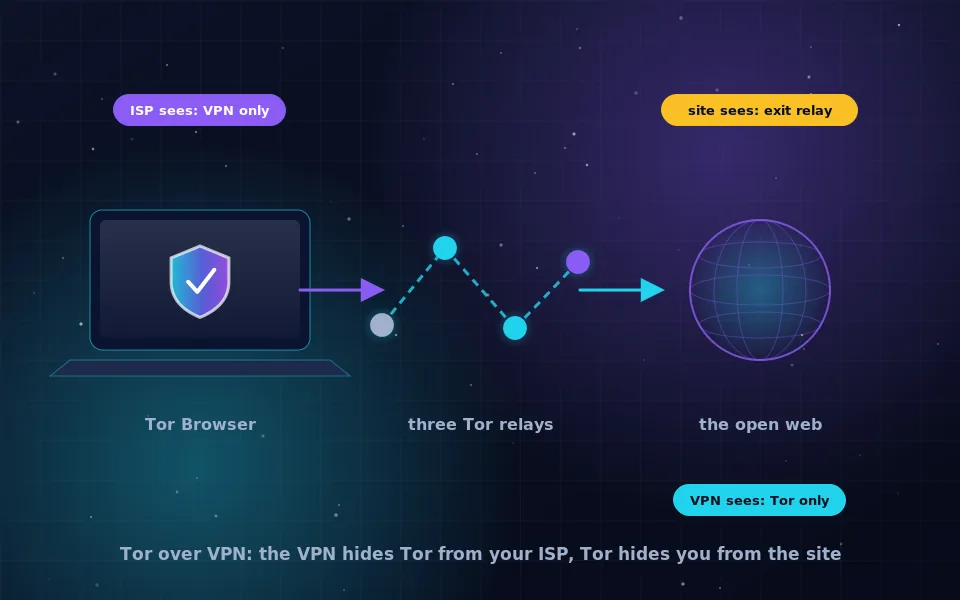
The best VPN for using Tor is one you would trust without Tor: audited no-logs policy, open protocols, a kill switch and anonymous payment. Most people do not need one, because Tor Browser already hides your IP address from websites; a VPN mainly adds value when you want your internet provider not to see that you are using Tor.
Searches for an anonymous VPN and for the best VPN for Tor tend to come from the same worry: that one tool is not enough. That instinct is healthy, but stacking tools without understanding what each one hides can make things worse rather than better. This article explains what Tor protects, what a VPN protects, the two orders in which they can be combined, the situations where the combination genuinely helps, and how to judge a provider without relying on a ranking page written by someone paid per signup.
What Tor hides and what it does not
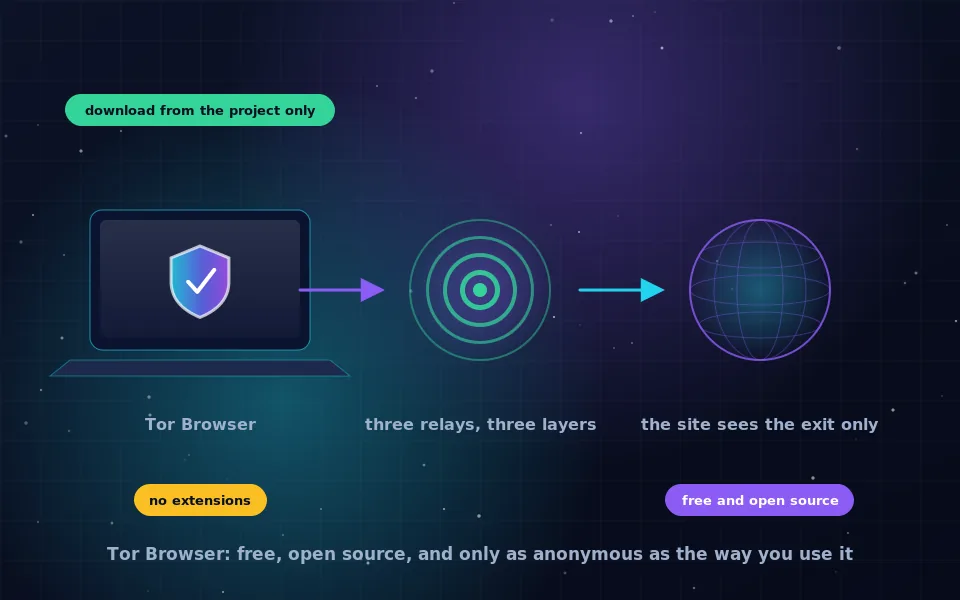
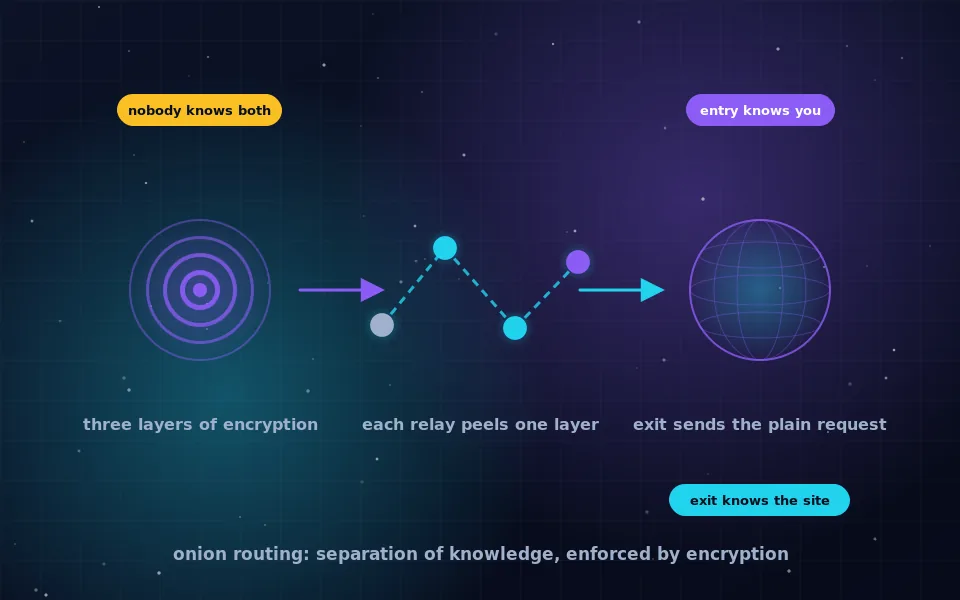
Tor Browser routes your traffic through three volunteer relays. The first relay sees your real IP address but not your destination; the last relay, the exit, sees the destination but not your address; the middle relay sees neither. Websites see only the exit relay's address. That is strong protection for where you are.
What Tor does not hide is the fact that you are using Tor. Your internet provider, or the operator of the Wi-Fi network you are on, can see a connection to a known Tor entry relay. In most places that is unremarkable. In some workplaces, campuses and countries it is blocked, throttled or noticed. Tor also does not protect you from yourself: logging in to a personal account over Tor links that session to you regardless of the relays.
What a VPN hides and what it does not
A VPN encrypts everything between your device and the VPN server and replaces your IP address with the server's. Your ISP sees an encrypted connection to one company and nothing else. The VPN company, in turn, sees your real address and everything you connect to, which is why the entire question of VPN trust comes down to logging.
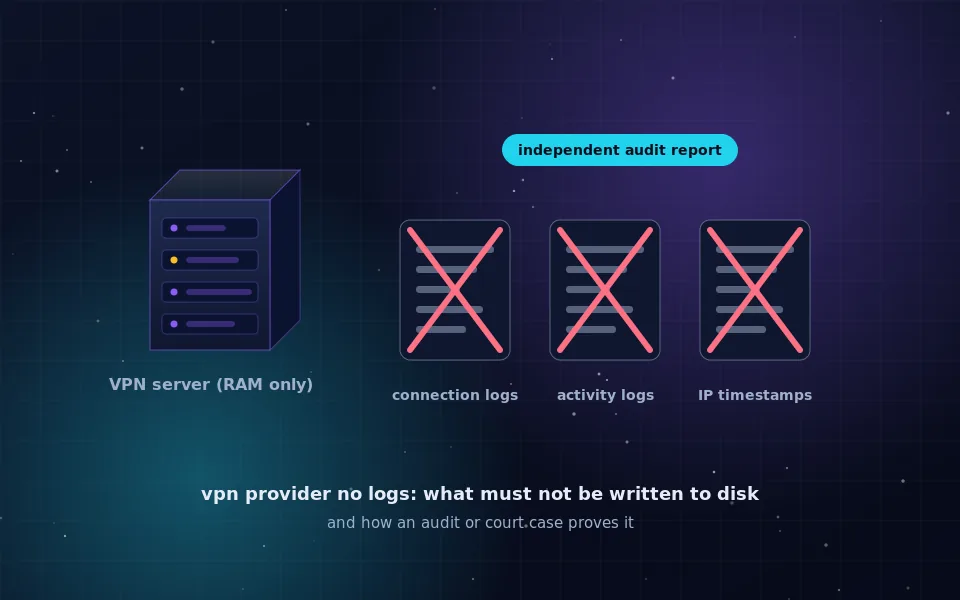
A VPN alone is not anonymity. It moves trust from your ISP to the provider. If the provider keeps records, or is compelled to start keeping them, the protection is gone. The no-logs guide on this site explains how to read a policy and which audits mean something.
Tor over VPN: the sensible order
Tor over VPN means you connect the VPN first, then open Tor Browser. The chain looks like this: your device, then the VPN server, then the three Tor relays, then the website.
Who sees what changes in a useful way. Your ISP sees only the VPN connection and cannot tell you are using Tor. The VPN provider sees that you connected to Tor but cannot see where Tor took you, because everything inside Tor is encrypted to the relays. The Tor entry relay sees the VPN server's address instead of yours. The website sees the exit relay, exactly as before.
This is the configuration that helps when your network blocks or throttles Tor, when you do not want your ISP to know you use it, or when you simply do not want your home address to be the one a Tor entry relay records. It costs some speed and adds a provider you have to trust with the knowledge that you use Tor.
VPN over Tor: usually a mistake
VPN over Tor reverses the order: Tor carries your traffic to the VPN server, and the VPN server reaches the internet. Websites then see the VPN's address instead of a Tor exit, which can get around sites that block Tor exits.
The problems outweigh that benefit for almost everyone. The VPN provider now sits at the end of the chain and sees everything you do, and if you paid with anything traceable the provider can connect that activity to you. Tor Browser's protections against fingerprinting and tracking still apply, but you have given a single company the complete picture that Tor's design exists to prevent. It is also awkward to set up, because most VPN apps are not designed to be routed through Tor, and a misconfiguration can send traffic outside Tor entirely. Unless you have a precise, well-understood reason, do not do this.
When the combination helps and when it does not
A short decision list keeps this honest.
- Your ISP or network blocks or throttles Tor: Tor over VPN helps, because the ISP sees only the VPN.
- You do not want your ISP to know you use Tor: Tor over VPN helps.
- You are on public Wi-Fi and want everything, including non-Tor apps, encrypted from the network operator: a VPN helps, whether or not you also run Tor.
- You want websites to stop treating you as a Tor user: the combination does not help in the safe order, and the unsafe order costs you your anonymity to the VPN provider.
- You want to be faster on Tor: the combination does not help; Tor's relays set the speed.
- You want protection against your own mistakes, such as logging in to real accounts: neither tool helps.
If none of the first three apply, run Tor Browser on its own. That is what the Tor Project's own guidance recommends for most users.
How to judge a VPN for anonymous surfing
Ranking pages that promise the best anonymous VPN are almost always funded by referral commissions, and the order of the list reflects the payout. Judge for yourself with criteria that can be checked.
- Logging policy and audit. The provider should publish a clear no-logs policy and have had it examined by an independent auditor, with the report available to read. Marketing that says "military-grade" and nothing specific is a warning sign.
- Protocols. WireGuard and OpenVPN, ideally both, with configuration files available so you are not locked to the app. Proprietary-only protocols make independent verification harder.
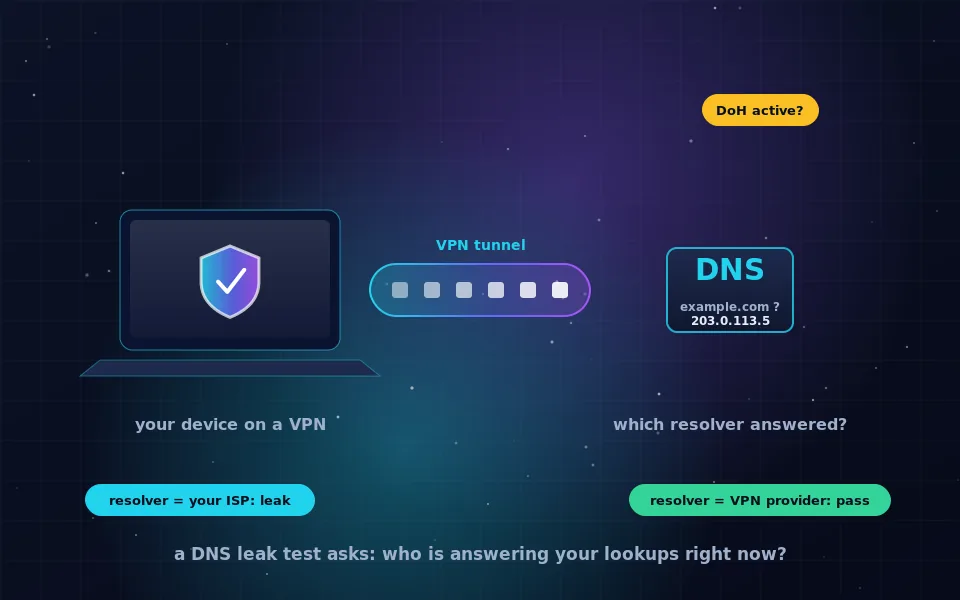
- Kill switch and DNS handling. The app should block all traffic if the tunnel drops and force DNS through the tunnel. Verify with a leak test rather than taking the feature list on faith.
- Anonymous signup and payment. No name or phone number required, and a way to pay that is not tied to your identity, such as cash by post or a privacy-preserving payment method, if that matters to your situation.
- Jurisdiction and transparency. Read where the company is based, how it has responded to legal requests, and whether it publishes transparency reports. History matters more than location alone.
- Business model. A paid service with a clear price. Free VPNs for anonymous browsing are almost always monetised through data or advertising, which is the opposite of what you are trying to achieve.
The safety guide on this site goes deeper into each of these points.
Setting up Tor over VPN without breaking either
The mechanics are simple, but the details keep the protection intact.
Connect the VPN and wait for the app to confirm the tunnel. Run a leak test so you know the VPN is working on its own. Then open Tor Browser normally; it will build its circuit through the VPN. Do not change Tor Browser's proxy settings and do not install extensions, because both make you stand out from other Tor users. Keep the VPN kill switch on so that if the tunnel drops, Tor traffic does not suddenly leave from your real address. Finally, keep your everyday browsing in a separate browser or, better, do not mix Tor sessions with logged-in accounts at all.
What the Tor Project and researchers say
The advice above matches what the people who build and study these tools have said publicly, which is a useful check against forum folklore.
The Tor Project's support documentation states that using a VPN with Tor is generally unnecessary for most users, that it can help in the specific case of an ISP that blocks Tor, and that a VPN provider becomes a party you must trust. It advises against VPN over Tor for ordinary use.
Academic researchers who study anonymity networks have repeatedly pointed out that adding hops does not add anonymity in proportion; the strength of Tor comes from the size and diversity of its user base and relay set, not from the number of encrypted layers. Being one of many identical Tor users protects you more than being the one person with an unusual chain.
Security practitioners who audit VPN clients note that the most common real-world failures are leaks during reconnection and DNS escaping the tunnel. In a Tor over VPN setup those leaks reveal Tor use to the ISP, which is precisely the thing the VPN was added to hide, so a kill switch and a leak test are not optional.
Decide, then keep it simple
If your network does not block Tor and you are comfortable with your ISP knowing you use it, open Tor Browser and skip the VPN. If either of those is a problem, choose a provider using the checklist above, connect it first, verify with a leak test, and then start Tor. Whatever you choose, the relays and the tunnel protect your location only; the habits described in the anonymity guides protect the rest.
Frequently asked questions
Do I need a VPN to use Tor safely?
No. Tor Browser is designed to be used on its own and protects your IP address from the sites you visit without any VPN. A VPN is an optional extra that mainly hides the fact that you are using Tor from your internet provider.
What is the difference between Tor over VPN and VPN over Tor?
Tor over VPN means you connect to the VPN first and then open Tor Browser, so your ISP sees only the VPN. VPN over Tor means Tor carries your traffic to the VPN server, which then reaches the internet; it is rarely useful and hard to set up correctly. Almost everyone who combines them should use Tor over VPN.
What makes a VPN good for anonymous browsing with Tor?
A published and audited no-logs policy, native support for the WireGuard or OpenVPN protocols, a kill switch, acceptance of anonymous payment, and no requirement for personal details at signup. Speed matters less, because Tor itself is the slow part.
Can a VPN make Tor faster?
Not in general. Tor's speed is limited by the relays, not by your connection. A VPN can help only when your ISP throttles or blocks Tor traffic, in which case hiding Tor inside the VPN removes the throttling.
Is using Tor with a VPN completely anonymous?
No combination of tools is completely anonymous. Tor with or without a VPN protects your network location; it does nothing about the accounts you log into, the files you download, or the habits that identify you. The anonymity guides on this site cover those layers.
Last reviewed and updated on . Plain text version: /vpn/vpn-with-tor.txt.